





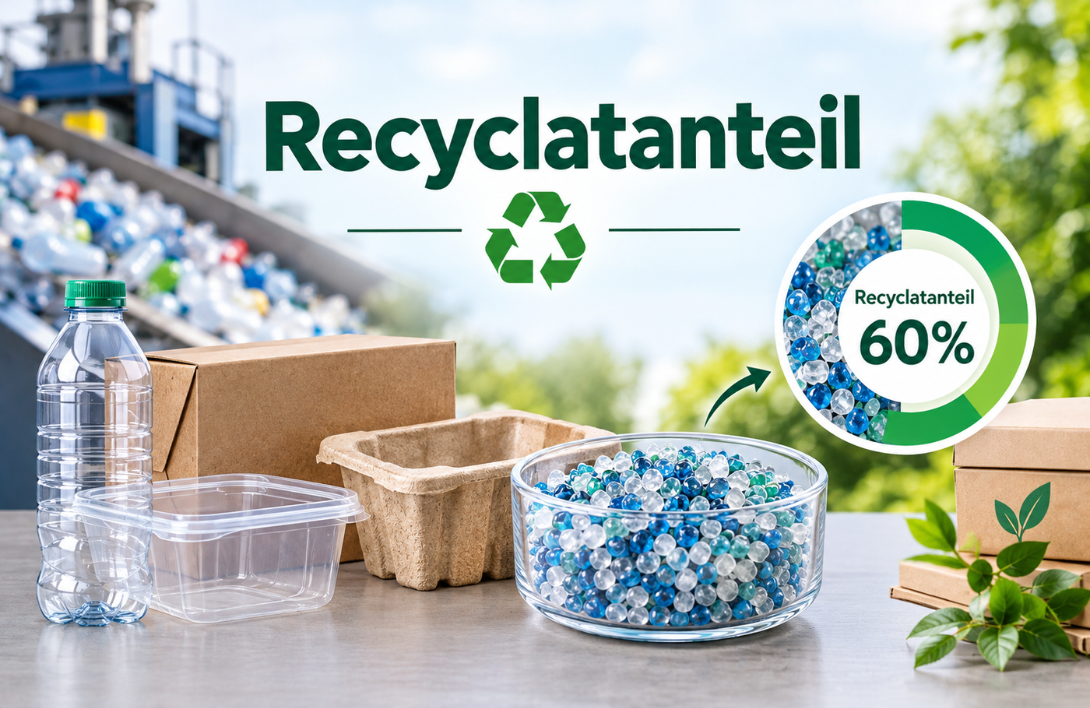
Recyclatanteil means the percentage or share of recycled material contained in a product, component, or package. It shows how much of the measured material comes from recovered resources rather than entirely from virgin raw materials.
In practical terms, a product containing 30% recycled material has a 30% recycled-content share for the material or scope being measured. The important detail is knowing what the percentage applies to and where the recycled material came from.
What Is Recyclatanteil?
Recyclatanteil is a German term describing the share of recycled material in a product, packaging item, material, or component.
For example, imagine a packaging component made from 60 kilograms of recycled plastic and 40 kilograms of virgin plastic. If those are the materials included in the calculation, the recycled-content share is 60%.
The basic formula is:
Recyclatanteil = recycled material ÷ total measured material × 100
The term is closely connected with ideas such as recycled content, secondary raw materials, resource conservation, and the circular economy.
However, the percentage alone does not tell the complete environmental story. A 50% recycled-content claim becomes much more useful when you also know whether the material is post-consumer or post-industrial, which component it applies to, and how the claim was documented.
How Is Recyclatanteil Calculated?
The calculation is straightforward when the material boundaries are clear.
For example:
- Total material: 100 kg
- Recycled material: 40 kg
- Virgin material: 60 kg
The calculation is:
40 ÷ 100 × 100 = 40% recycled content
The difficult part is often not the mathematics but defining the scope.
A package may contain plastic, paper, adhesive, ink, coating, labels, and other components. A manufacturer might report recycled content for only the plastic component rather than the complete package.
A practical way to check this is to ask: “40% of what?”
That single question can prevent misleading comparisons.
Post-Consumer vs. Post-Industrial Recycled Content
Not all recycled material comes from the same source.
| Type | Meaning | Example |
| Post-Consumer Recycled (PCR) | Material recovered after a consumer has used and discarded it | Used beverage bottles |
| Post-Industrial Recycled (PIR) | Material recovered from manufacturing processes | Production offcuts or factory scrap |
PCR is often particularly important when evaluating how effectively consumer waste is being returned to productive use.
PIR can also reduce waste and resource consumption, but it generally comes from production processes before a finished product reaches the consumer.
The distinction matters because two products could both claim 50% recycled content while using very different recycled-material streams.
Why Recyclatanteil Matters for Packaging and Manufacturing
Recycled content can reduce reliance on virgin resources and create demand for recovered materials.
When manufacturers use recycled feedstock, recycling systems have a destination for the materials they collect and process. This creates a connection between waste collection and actual manufacturing demand.
The potential benefits include:
- Reduced use of virgin raw materials
- Greater use of recovered resources
- Support for circular-material supply chains
- Reduced dependence on newly extracted resources
- Potential reduction in waste going to disposal
- More measurable sustainability reporting
However, recycled content should not be treated as the only measure of environmental performance.
A durable product that lasts significantly longer may perform differently from a short-lived product with a higher recycled-content percentage. Energy use, transportation, manufacturing, repairability, recyclability, and end-of-life treatment can all matter.
How to Check Recycled Content in Real-World Products
If you are evaluating a recycled-content claim, use a simple process.
Step 1: Identify the exact material
Determine whether the percentage refers to plastic, paper, glass, metal, textile fiber, or another material.
Step 2: Check the scope
Find out whether the percentage covers the entire product, the packaging, or only one component.
Step 3: Identify the source
Look for PCR, PIR, or another clearly defined source of recycled material.
Step 4: Look for documentation
For business purchases, useful evidence can include supplier declarations, technical specifications, sustainability reports, traceability records, and applicable third-party certification.
Step 5: Check the calculation method
Two manufacturers may use different boundaries or calculation methods. Make sure you are comparing like with like.
Step 6: Consider the whole product
Finally, look beyond the percentage. Consider durability, functionality, recyclability, material complexity, and end-of-life options.
What Most Recycled-Content Guides Miss
What most guides miss is that the percentage is only meaningful when its measurement boundary is clear.
A label saying “50% recycled material” sounds precise, but several questions remain:
- Is the 50% for the whole product?
- Does it refer only to packaging?
- Is it calculated by weight?
- Is the recycled material PCR or PIR?
- Is the percentage averaged across production?
- Can the supplier provide supporting documentation?
- Does the product remain recyclable after incorporating the recycled material?
These details become especially important for companies making environmental claims or comparing suppliers.
A high percentage without clear scope is not necessarily more informative than a lower percentage with excellent traceability.
Recyclatanteil vs. Recyclability: They Are Not the Same
This distinction is essential.
| Concept | Main question |
| Recyclatanteil | How much recycled material is already in the product? |
| Recyclability | Can the product or material be effectively recycled after use? |
A product can contain recycled material but still be difficult to recycle at the end of its life.
Conversely, a product can be highly recyclable while containing little or no recycled content because it was made primarily from virgin material.
The strongest packaging strategies consider both sides: using recovered material today and designing products that can be recovered tomorrow.
A Practical Workflow for Evaluating a Recycled-Content Claim
For a consumer, the workflow can be as simple as:
Claim → Scope → Material source → Evidence → End-of-life → Overall decision
For a business, add:
Supplier documentation → Batch or production records → Calculation methodology → Compliance review
From what I’ve seen, the biggest improvement in evaluating sustainability claims comes from asking precise questions instead of relying on broad words such as “eco-friendly.”
In real use, documentation often matters as much as the percentage itself.
A supplier reporting 35% recycled content with clear material specifications may provide more useful information than another supplier advertising “high recycled content” without defining the figure.
Recyclatanteil in 2026: Regulation and Industry Trends
Recycled content is becoming more important in European packaging policy.
The EU Packaging and Packaging Waste Regulation (PPWR) establishes minimum recycled-content requirements for certain plastic packaging, with targets beginning from 2030 and increasing toward 2040. The exact requirement depends on the packaging category and material.
The European Commission says the PPWR will begin applying from mid-2026 and is intended to increase recycling, reduce packaging waste, improve resource efficiency, and promote circular use of materials.
Germany has also adopted the Verpackungsrecht-Durchführungsgesetz (VerpackDG) in 2026 to support implementation of the EU packaging framework. The German legislation includes measures concerning recycling, packaging design incentives, and the use of recyclates.
For businesses, the important lesson is that recycled content is increasingly becoming a compliance and supply-chain issue, not merely a marketing topic.
Because implementation details can change, companies should verify the current rule applicable to their specific packaging, market, material, and date before making compliance decisions.
When Higher Recycled Content Is Not Automatically Better
More recycled content can be beneficial, but “higher” should not automatically mean “better.”
A recycled material may have different characteristics from virgin material. Depending on the application, manufacturers may need to manage purity, color, strength, contamination, processing behavior, food-contact requirements, or other technical specifications.
A common mistake is to compare two percentages without checking what each percentage represents.
For example:
- Product A: 50% recycled content in the complete package
- Product B: 70% recycled plastic in one component
Product B does not necessarily contain more recycled material overall.
The comparison needs a common measurement boundary.
Which Recycled-Content Approach Is Best?
| Option | Best For | Strength | Weakness | Risk | Final Verdict |
| High PCR content | Consumer packaging with suitable feedstock | Strong connection to post-consumer recycling | Feedstock quality can vary | Medium | Excellent when technically suitable |
| PIR content | Manufacturing efficiency | Can reuse production waste efficiently | Does not represent post-consumer recovery | Low–Medium | Useful but should be clearly identified |
| Lower recycled content with strong traceability | Regulated or demanding applications | Easier verification and quality control | Less recycled input | Low | Good where technical requirements are strict |
| High recycled content without clear documentation | Marketing-led claims | Attractive headline percentage | Difficult to verify | High | Avoid unless evidence is available |
| Recycled content + recyclable design | Circular packaging strategy | Addresses both input and end-of-life | Requires better design and infrastructure | Low–Medium | Best overall approach |
Choose this if…
Choose higher recycled content when the material is technically suitable, the percentage is clearly defined, and reliable documentation supports the claim.
Avoid this if…
Avoid making decisions based only on a large percentage when the scope, source, calculation method, or supporting evidence is unclear.
Best overall choice
The strongest approach is usually appropriate recycled content + transparent sourcing + good product performance + practical recyclability.
Common Mistakes, Risks and Limitations
A common mistake is treating recycled content and recyclability as interchangeable terms.
What most guides miss is the importance of measurement boundaries. A percentage without a clear scope can make two products appear comparable when they are not.
This may fail when the available recycled feedstock does not meet the technical or safety requirements of the intended application.
Other common problems include:
- Assuming 100% recycled content is always technically preferable
- Ignoring whether material is PCR or PIR
- Comparing percentages calculated using different boundaries
- Treating an environmental marketing statement as proof
- Forgetting that product durability also matters
- Assuming a recycled-content product will automatically be recyclable
- Ignoring local collection and recycling infrastructure
- Using outdated regulatory information
For regulated packaging, always verify the current legal requirements before publishing compliance claims or making procurement decisions.
Real Use Workflow: How to Evaluate a Recycled-Content Claim
A realistic evaluation can follow six steps:
- Read the claim — Identify the stated recycled percentage.
- Define the scope — Determine whether it covers the product, package, or a component.
- Identify the source — Check whether it is PCR, PIR, or another recycled input.
- Request evidence — For business purchasing, ask for technical or supplier documentation.
- Check technical suitability — Confirm that recycled material meets the required performance.
- Evaluate the complete product — Consider durability, recyclability, disposal, and material complexity.
Common real-world issue: A supplier may advertise a recycled percentage without explaining whether it applies to the complete product or only one material.
Practical fix: Ask for the percentage by material and component, together with the calculation basis and supporting documentation.
Comparison and Decision Framework
The most useful comparison is not simply “high recycled content vs. low recycled content.”
Instead, evaluate:
Percentage + source + scope + evidence + performance + recyclability
Best option for consumers
Look for clear recycled-content information and determine whether the claim applies to the product or only its packaging.
Best option for manufacturers
Choose recycled feedstock that meets technical specifications while maintaining reliable traceability and quality.
Best option for procurement teams
Request standardized information from suppliers so competing recycled-content claims can be compared using the same measurement boundaries.
Best option for packaging designers
Combine appropriate recycled content with material simplicity, recyclability, durability, and realistic end-of-life infrastructure.
Mistakes, Risks and Limitations
Mistake 1: Treating a percentage as the whole environmental story
Recycled content is useful, but it does not measure every environmental impact.
Mistake 2: Ignoring material origin
PCR and PIR can represent different stages of the material cycle.
Mistake 3: Comparing incompatible percentages
A package-level percentage cannot automatically be compared with a component-level percentage.
Mistake 4: Assuming recycled always means recyclable
The material already being recycled does not guarantee that the finished product can be recycled again.
Mistake 5: Relying on outdated regulation
Packaging requirements can change. For 2026 and beyond, businesses operating in Europe should verify the latest PPWR and national implementation requirements before relying on a legal claim.
Limitation
Recycled material availability can vary by material, geography, infrastructure, quality requirements, and market demand. Therefore, the theoretically desirable recycled-content percentage may not always be technically or commercially achievable.
FAQs
What does Recyclatanteil mean?
Recyclatanteil means the share of recycled material contained in a product, material, component, or package. The percentage is meaningful only when its measurement scope is clearly defined.
Is a higher Recyclatanteil always better?
No. Higher recycled content can reduce reliance on virgin material, but durability, product performance, recyclability, sourcing, and end-of-life options also matter.
How is Recyclatanteil calculated?
It is generally calculated by dividing the amount of recycled material by the total amount of material covered by the calculation and multiplying by 100. The exact calculation boundary should be checked before comparing claims.
Can recycled content make packaging harder to recycle?
Sometimes. The effect depends on the material, additives, combinations, contamination, and available recycling technology. Recycled content and recyclability should therefore be evaluated separately.
What is the biggest risk when comparing recycled-content claims?
The biggest practical risk is comparing percentages that use different scopes or calculation methods. A clear 40% claim for an entire package may be more informative than an unclear 70% claim for only one component.