

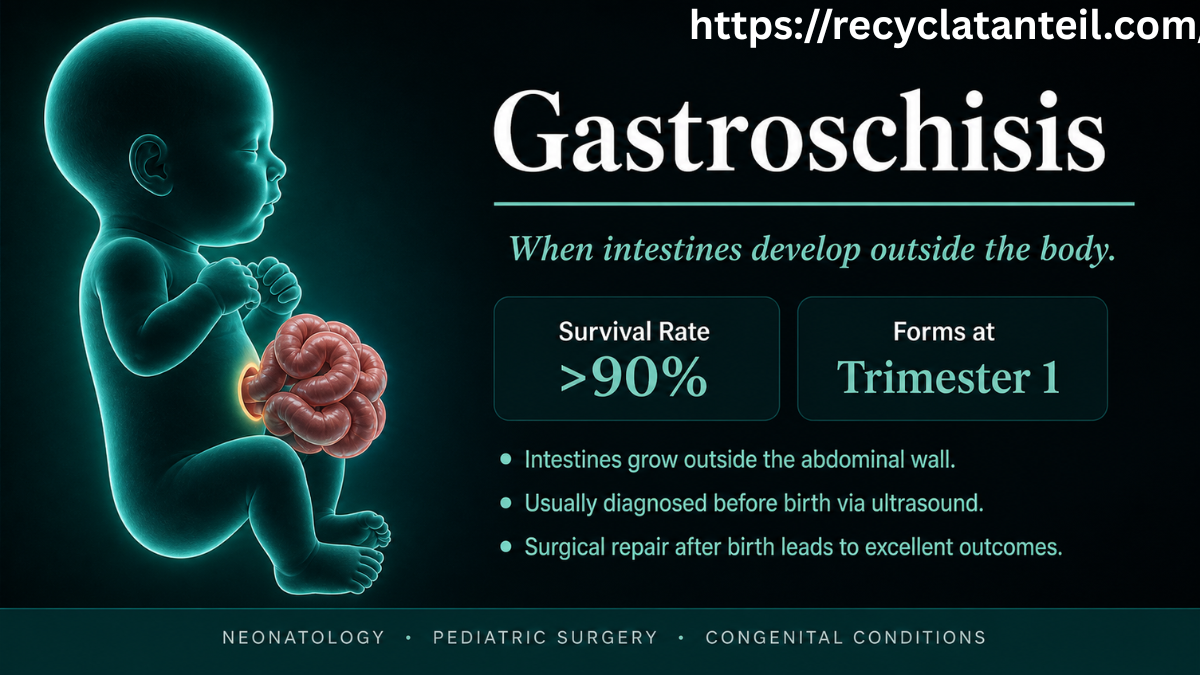
Gastroschisis is a birth defect where a baby is born with intestines outside the body through a small opening in the abdomen. It requires immediate surgery and specialized care, but with modern treatment, survival rates exceed 90%. The real challenge is not just surgery—it’s how well the baby’s digestive system recovers afterward.
What Is Gastroschisis? (Simple Explanation for Parents)
Gastroschisis is a congenital condition where a baby’s intestines develop outside the body, usually to the right of the belly button. Unlike similar conditions, there is no protective sac covering the organs, which makes immediate medical care essential.
This condition falls under abdominal wall defects and is managed by specialists in Neonatology and Pediatric Surgery. The exposed intestines are vulnerable to irritation from amniotic fluid before birth and infection after delivery.
How Gastroschisis Develops During Early Pregnancy
Gastroschisis forms very early—usually in the first trimester—when the abdominal wall does not close completely. This happens before most mothers even know they are pregnant.
From what I’ve seen, many parents assume something went wrong later in pregnancy, but this is actually a timing issue during early fetal development. The intestines remain outside and are exposed to amniotic fluid, which can cause inflammation and thickening.
This early origin explains why prevention is limited and why early detection is more important than trying to “fix” risk factors later.
What Causes Gastroschisis? Risk Factors vs Myths
The exact cause is still unknown, but research points to a combination of environmental and developmental factors rather than a single trigger.
Common risk factors include younger maternal age, exposure to smoking or harmful substances, and poor early pregnancy nutrition.
A common mistake is believing that gastroschisis is caused by something the mother did wrong. In reality, most cases occur randomly. It is not typically inherited and rarely linked to family genetics.
Organizations like World Health Organization emphasize that this condition is largely unpredictable, reinforcing the importance of prenatal care rather than blame.
How Doctors Diagnose Gastroschisis Before Birth
Gastroschisis is usually detected during a routine ultrasound around 18–20 weeks of pregnancy. The diagnosis is typically clear and does not require complex testing.
Doctors monitor several factors after diagnosis, including fetal growth, amniotic fluid levels, and the condition of the intestines.
Hospitals guided by institutions like Mayo Clinic follow consistent imaging protocols to ensure accurate and early detection.
Gastroschisis vs Omphalocele: Key Differences That Matter
Gastroschisis is often confused with Omphalocele, but the difference is critical for treatment and outcomes.
Gastroschisis involves exposed intestines without a covering and usually appears to the right of the belly button. Omphalocele involves organs enclosed in a thin sac and is more often associated with other conditions.
In real use, gastroschisis requires faster intervention because the organs are directly exposed, increasing the risk of infection and fluid loss.
What Happens Immediately After Birth? (Critical First Hours)
The first hours after birth are crucial. Medical teams act quickly to stabilize the baby and protect the exposed organs.
This typically involves covering the intestines with sterile materials, maintaining body temperature, and preparing for surgery. The baby is then transferred to a neonatal intensive care unit, commonly known as NICU care.
From what I’ve seen, parents are often overwhelmed during this phase because everything happens rapidly. However, this fast response is exactly what improves survival outcomes.
Treatment Options Explained: Surgery and NICU Care
Treatment always involves surgery, but the approach depends on the severity of the condition.
Primary closure is used when the intestines can be placed back into the abdomen in one operation. Staged repair uses a silo, a protective pouch that gradually moves the intestines back inside over several days.
In real use, staged repair is more common because swelling often prevents immediate closure.
A key insight is that surgery alone does not determine success. The role of NICU care—monitoring, infection control, and nutritional support—is equally important.
Step-by-Step Recovery Timeline After Surgery
Recovery is a gradual process rather than an instant fix. After surgery, babies remain in the NICU for close monitoring.
The first phase involves intravenous nutrition because the intestines are not ready to process food. The second phase introduces feeding slowly as bowel function improves. The final phase focuses on growth and preparing for discharge.
From what I’ve seen, feeding progression is often the slowest and most critical step. Parents sometimes expect rapid improvement, but recovery can take weeks.
Common Complications and Hidden Risks Parents Miss
Complications can include infection, bowel obstruction, and feeding difficulties.
A common mistake is assuming that once surgery is complete, the problem is solved. In reality, the intestines may take time to function properly.
Feeding intolerance is one of the most overlooked risks. Babies may struggle to digest milk, leading to longer hospital stays and the need for extended nutritional support.
Information Gain: Why Feeding Matters More Than Surgery
Most articles focus heavily on surgery, but what competitors often miss is that long-term success depends on how well the intestines function afterward.
Surgery restores structure, but feeding determines recovery.
In 2026, advancements in neonatal care are shifting focus toward nutrition protocols and gut function recovery. Emerging technologies, including Artificial Intelligence and Natural Language Processing, are even being explored to improve prenatal diagnosis and care planning.
This shift highlights a new reality: survival is expected, but quality of life depends on digestive performance.
Real Parent Experience: Life Inside the NICU
From what I’ve seen, the NICU experience is emotionally intense. Parents often describe long waiting periods, uncertainty, and anxiety about feeding progress.
In real use, progress is measured in small milestones. The first successful feeding or removal of a tube becomes a major achievement.
This experience adds depth beyond clinical explanations and shows that recovery is not just medical—it is emotional and gradual.
Bringing Your Baby Home: What Changes After NICU
Going home is a major milestone, but it is not the end of care. Parents must continue monitoring feeding, growth, and overall development.
Regular checkups and feeding routines become part of daily life. Many babies catch up in growth within the first year, but consistency is key.
From what I’ve seen, confidence builds over time as parents become familiar with their baby’s needs and signals.
Mistakes to Avoid After Gastroschisis Treatment
One of the biggest mistakes is expecting a quick recovery. Healing takes time, especially when it comes to digestion.
Another common issue is overlooking feeding problems. Early signs of intolerance should not be ignored.
Skipping follow-up appointments is also risky, as ongoing monitoring is essential for long-term health.
Long-Term Outcomes: Growth, Digestion, and Development
Most children with gastroschisis grow up healthy and lead normal lives. Some may experience mild digestive issues early on, but these often improve with time.
Long-term outcomes depend more on post-surgery care than the condition itself. With proper management, children typically achieve normal growth and development.
Is Gastroschisis Treatment Worth It? (Final Decision Guide)
Yes, treatment is absolutely worth it. Survival rates exceed 90% in well-equipped hospitals, and most babies go on to live healthy lives.
What sounds good is the idea of a quick surgical fix. What actually happens is a gradual recovery that requires patience, monitoring, and support.
The decision becomes clearer when you understand the full picture. Surgery restores anatomy, but recovery depends on feeding, care, and time.
The most important takeaway is that outcomes today are highly positive. With early diagnosis, expert care, and realistic expectations, families can move forward with confidence and clarity.
You May Also Like Eo Pis
FAQS
1. Is gastroschisis life-threatening or survivable today?
Gastroschisis is serious, but it is highly survivable with modern care. Survival rates exceed 90% in well-equipped hospitals. The key factor is access to NICU care and timely surgery, not just the condition itself.
2. What is the biggest challenge after gastroschisis surgery?
The biggest challenge is often feeding and digestion, not the surgery. Many babies take weeks to tolerate milk, and feeding intolerance can delay recovery more than the operation itself.
3. Can gastroschisis cause long-term problems later in life?
Most children grow up healthy, but some may experience bowel issues, slow digestion, or sensitivity to certain foods early in life. In rare cases, complications like bowel obstruction can occur later.
4. Did something during pregnancy cause gastroschisis?
No, in most cases gastroschisis is not caused by anything the parents did. While risk factors like young maternal age or smoking exist, the condition usually occurs randomly and is not preventable.
5. Should parents choose special hospitals for delivery if gastroschisis is diagnosed?
Yes, delivery in a hospital with NICU and pediatric surgery is critical. Choosing the right facility can significantly improve outcomes, reduce complications, and speed up treatment after birth.
